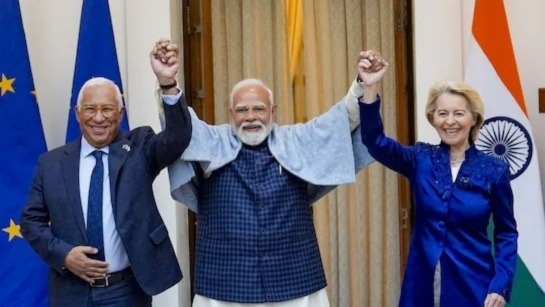
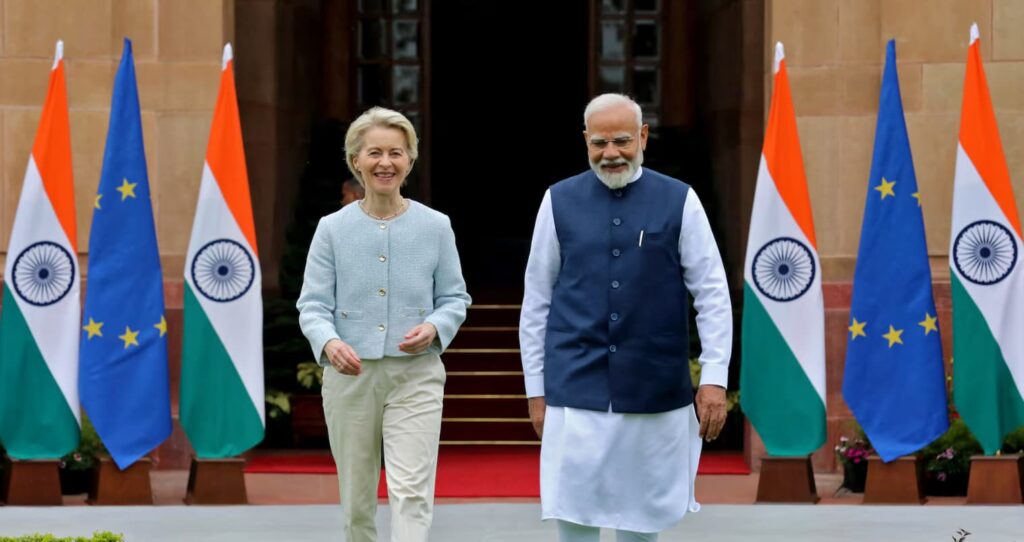
India has made a significant move in the global trade arena by signing a Free Trade Agreement (FTA) with the European Union (EU). This agreement, which has been reached after almost two decades of talks, has been termed as one of the most significant trade agreements that India has entered into in recent years.
Prime Minister Shri Narendra Modi has termed this agreement as the “Mother of All Deals.”
A Long-Awaited Agreement
The negotiations between India and the EU started almost two decades ago, but the differences in tariffs, market access, and regulatory matters kept hampering the progress. The recent development is the result of the changing global dynamics, which include supply chain disruptions, geopolitical tensions, and a common need to enhance economic cooperation.
The European Union is a group of 27 nations and is one of the largest and richest markets in the world. Access to this market has been a long-standing aim for India.
What Is a Free Trade Agreement?
A Free Trade Agreement is intended to facilitate trade by eliminating or reducing import duties. In other words, it enables companies to export their products and services across international borders at a lower cost.
As part of the India-EU Free Trade Agreement, a major share of Indian exports will attract lower or zero customs duties in Europe. Meanwhile, European products will gain improved market access in India.
How Indian Exporters Can Benefit
One of the major benefits of this agreement is the impetus it is likely to give to Indian exports. Indian goods will become more competitive in the European market because of the reduced tariffs.
The major sectors that are likely to benefit from this agreement are:
- Textiles and apparel
- Leather and footwear
- Gems and jewelry
- Engineering and industrial products
- Chemicals and pharmaceuticals
- Agricultural and processed foods
This agreement could bring about stability in business for exporters, particularly in sectors that are labor-intensive.
How Indian Exporters Can Benefit
One of the major benefits of this agreement is the impetus it is likely to give to Indian exports. Indian goods will become more competitive in the European market because of the reduced tariffs.
The major sectors that are likely to benefit from this agreement are:
- Textiles and apparel
- Leather and footwear
- Gems and jewelry
- Engineering and industrial products
- Chemicals and pharmaceuticals
- Agricultural and processed foods
This agreement could bring about stability in business for exporters, particularly in sectors that are labor-intensive.
What It Means for Indian Consumers
The deal is not just about export advantages. Indian consumers will also benefit as certain European imports will see reduced duties over time.
CNC machines, healthcare equipment, and precision industrial equipment may become more accessible, allowing Indian industries to upgrade. In the long run, certain high-quality consumer products from Europe may also be available at a relatively lower price.
Investment and Technology Flow
European businesses are at the forefront of innovative manufacturing, renewable energy, and precision engineering. The FTA will provide a stable investment framework, encouraging European businesses to increase their presence in India.
This may lead to:
- Enhanced foreign direct investment
- Technology transfer and innovation
- Training and development of human resources
These trends are in line with India’s vision of becoming a global manufacturing and technology destination.
Strategic Implications Other Than Trade
Apart from trade advantages, the India-EU FTA has strategic implications. With the changing landscape of global trade blocs, having stronger ties with Europe is expected to improve India’s reputation as a trustworthy and stable partner in international trade.
This agreement will also help India in its efforts to diversify trade and avoid being dependent on a few trade markets.
Approval and Implementation
Even though the trade agreement has been finalized, it still needs to go through the approval procedures in both India and the European Union. After the approval procedure, the implementation of the agreement will take place in phases to give time to the respective industries to adapt to the new scenario.
Challenges to Watch
Like all big trade agreements, the India-EU FTA also comes with some challenges. Indian industries will have to compete more, and Indian exporters will have to adhere to very tight European norms on quality, environment, and labor standards.
But policymakers and trade experts are of the view that these challenges are not insurmountable, and the long-term benefits will far outweigh the challenges in the short term.
A Turning Point in India’s Trade Policy
The India-EU Free Trade Agreement is a turning point in India’s trade policy. It is a sign of confidence in India’s manufacturing capabilities and a willingness to take on a leadership role in the global economy.
As the world of global trade continues to change, this agreement puts India firmly in the driver’s seat as an active and key player, and not just a passive one.
The India-EU FTA is more than just a trade agreement. It is a declaration of intent – that India is ready to compete, cooperate, and grow in the global arena. If done properly, this agreement can be the foundation of India’s economic policy in the next decade.